
Ametrine: When Two Colours Meet in One Remarkable Gemstone

Some gemstones are beautiful because of their colour. Others are fascinating because of the story behind how that colour was formed. Ametrine offers both.
Displaying shades of purple and golden yellow within a single gemstone, ametrine is an unusual variety of quartz that combines the colours traditionally associated with amethyst and citrine.
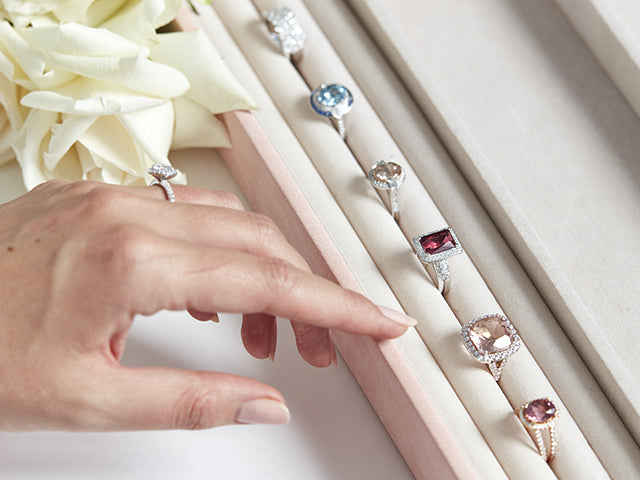
Recently, our jewellers at Foster & Co Family Jewellers in Hervey Bay had the opportunity to create a custom ring around a beautiful rectangular ametrine. Its distinctive transition from warm golden tones into rich purple made the gemstone the natural focal point of the finished piece.
But what exactly is ametrine, and how can one gemstone contain two such different colours?
What Is Ametrine?
Ametrine is a naturally occurring variety of quartz.
Quartz itself is one of the most abundant minerals on Earth and occurs in numerous colours and varieties. Two of its best-known gem varieties are amethyst, recognised for its purple colouring, and citrine, known for yellow through orange and golden tones.
Ametrine is particularly interesting because both colour zones occur within the same crystal.
The name itself reflects this combination:
AMEThyst + citRINE = AMETRINE
Rather than being two gemstones joined together, natural ametrine is a single quartz crystal displaying different colour zones.

What Creates the Purple and Golden Colours?
The colour story of ametrine begins with iron within the quartz crystal.
Very small amounts of iron are involved in producing the colours seen in amethyst and citrine. During the crystal's geological formation, different areas can experience different conditions, resulting in sections developing purple amethyst colouring while others develop yellow-to-golden citrine colouring.
The result can be a striking division or sometimes a more gradual transition between the two colours.
This natural colour zoning is one of the characteristics that makes ametrine so visually interesting. No two pieces need to display their colours in precisely the same way.
Understanding Colour Zoning
When looking at an ametrine, you may notice that its colour isn't uniform.
One portion may appear distinctly purple while another is golden or honey-coloured. Between them there may be an area where the colours seem to meet or blend.
This is known as colour zoning.
The way a rough crystal is orientated and cut can have an enormous influence on how these zones appear in the finished gemstone. A cutter may choose an orientation that creates a strong division between purple and yellow, or one that produces a softer transition across the stone.
That makes the cut about more than simply creating sparkle—it can also determine how the gemstone's natural colour story is presented.

The Ametrine in This Custom Ring
The ametrine selected for this Foster & Co custom piece provides a particularly beautiful example of why the gemstone is so interesting.
Viewed from the front, its rectangular faceted form reveals warm champagne and golden tones transitioning towards purple through the lower portion of the gemstone. As the ring is moved and viewed from different angles, the facets interact with the colour zones differently.
That means its appearance can subtly change with angle, movement and lighting.
Rather than trying to disguise this variation, a custom jewellery design provides an opportunity to celebrate it.
Designing Jewellery Around an Individual Gemstone
This is one of our favourite aspects of custom jewellery design.
When working with a distinctive gemstone such as ametrine, the stone itself can help guide the design.
Instead of selecting a gemstone simply to fit an existing setting, a custom piece can consider the gemstone's proportions, shape, colour distribution and individual character.
For this ring, the large rectangular ametrine forms the centrepiece. The yellow-gold setting complements its warmer colouring, while the surrounding diamond details introduce brightness without taking attention away from the centre stone.
The result is a ring designed to showcase something that cannot be completely replicated: the individual appearance of that particular gemstone.
Is Ametrine Rare?
Natural ametrine is considerably less commonly encountered than amethyst or citrine individually.
The world's best-known commercial source of natural ametrine is the Anahí mine in Bolivia, which is particularly famous for producing material displaying attractive purple and yellow colour zoning.
Ametrine can also be produced or altered through laboratory processes, so when purchasing an important gemstone, its origin and any treatments should be considered rather than assuming that every purple-and-yellow quartz has formed naturally in that state.

Is Ametrine Suitable for Jewellery?
Ametrine has the same fundamental mineral properties as quartz, including a hardness of 7 on the Mohs scale.
That makes it suitable for many types of jewellery, including rings, earrings and pendants. As with any gemstone, however, hardness is only one consideration. Jewellery should still be treated thoughtfully and protected from unnecessary knocks, harsh chemicals and abrasive wear.
For an ametrine ring in particular, the setting and overall design can play an important role in protecting the gemstone while allowing its colour and facets to remain visible.
A Gemstone That Rewards a Closer Look
Ametrine is a wonderful reminder that gemstones are more than simply decorative objects.
Their colours can provide clues to the conditions in which they formed, while cutting and jewellery design determine how those natural characteristics are ultimately presented.
In this custom ring, the meeting of purple and golden colour is not something we wanted to hide—it is precisely what makes the centre stone special.
And that is one of the pleasures of creating bespoke jewellery in Hervey Bay. An unusual gemstone does not necessarily need to conform to a standard design. Sometimes the most interesting approach is to begin with the stone itself and create the jewellery around it.
If you have an unusual gemstone, inherited stone or loose gem that deserves to be worn rather than kept away, visit Foster & Co Family Jewellers in Hervey Bay. Our team can explore the possibilities for creating an individual piece designed around the gemstone you already have or we can source one of your dreams.